Tallinn TV Tower Route: Heights of History
What you'll walk through
- 1
Chapter 1: Foundations of Signal
Built for Power
↓ Preview below - 2In the app
Chapter 2: Engineering Core
Built to Withstand the Sky
- 3In the app
Chapter 3: Path to Broadcast
Connecting Estonia
- 4In the app
Chapter 4: Barricade Point
Defending the Airwaves
- 5In the app
Chapter 5: View of Independence
Broadcasting the Future
Chapter 1 · Free preview
Built for Power
Signal from the Sky
When Tallinn was selected as the location for the sailing competitions during the 1980 Moscow Olympics, the Soviet Union faced a major technical gap. Estonia needed a modern broadcasting hub capable of sending long-distance television signals with clarity, stability, and Olympic-level reliability. Before this project, no structure in Estonia could transmit at such range. Pirita was chosen for a practical reason: its elevated forest landscape and distance from central Tallinn created ideal conditions for stable signal transmission without heavy urban interference. Planning for the Tallinn TV Tower began in 1975, transforming a quiet coastal woodland into one of the most strategically important Cold War engineering sites in the Baltic region. The completed structure would not only serve the Olympics — it would become one of the most powerful communication points in the Soviet North-West, capable of reaching far beyond Estonia.
Cold War Engineering
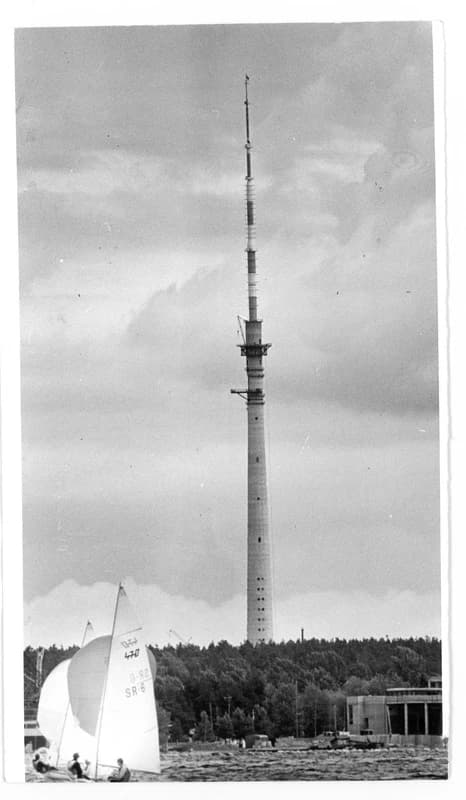
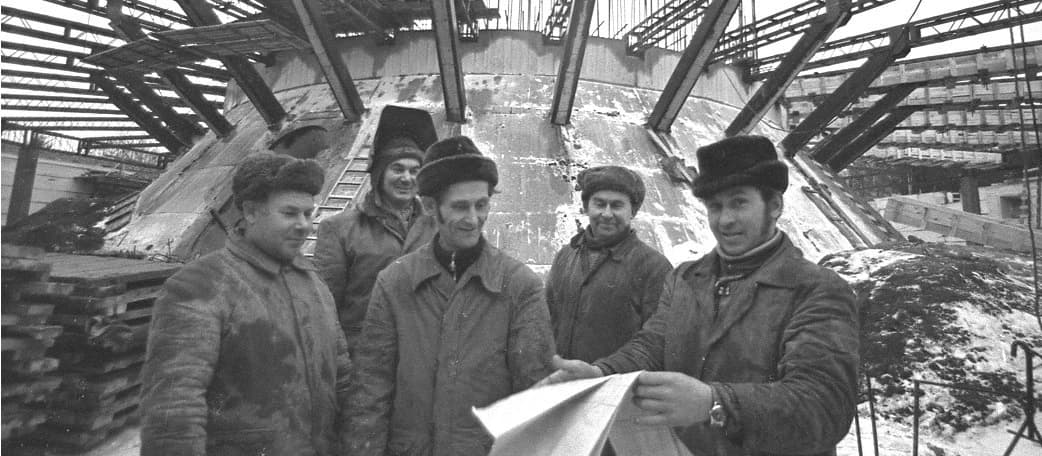
Construction of the TV Tower combined 10,000 m³ of reinforced concrete and a 124-meter steel mast, making it one of the largest media engineering projects in the region. The tower was designed to be completed before the Olympic sailing events began, and deadlines became increasingly urgent. To speed up the work, highly specialized transmission equipment originally assigned to the Vilnius TV Tower was redirected to Tallinn — a clear sign of the tower's importance to Olympic broadcasting strategy. The first official transmission was carried out on 20 December 1979, enabling signal testing and allowing Olympic preparations to begin months in advance. From this point onward, Tallinn was no longer a peripheral Soviet city — it became a key node in the USSR's northern broadcasting network, capable of reaching across the Baltic Sea and providing both civilian and international media links from Estonia.
The story keeps going — 12 more stops on the street
This was the beginning of chapter 1 of 5. The full route walks you stop by stop through Tallinn with audio narration in English, Estonian, and Russian, historical photos at every point, and XP for your Explorer Passport. Free, self-guided, no booking.